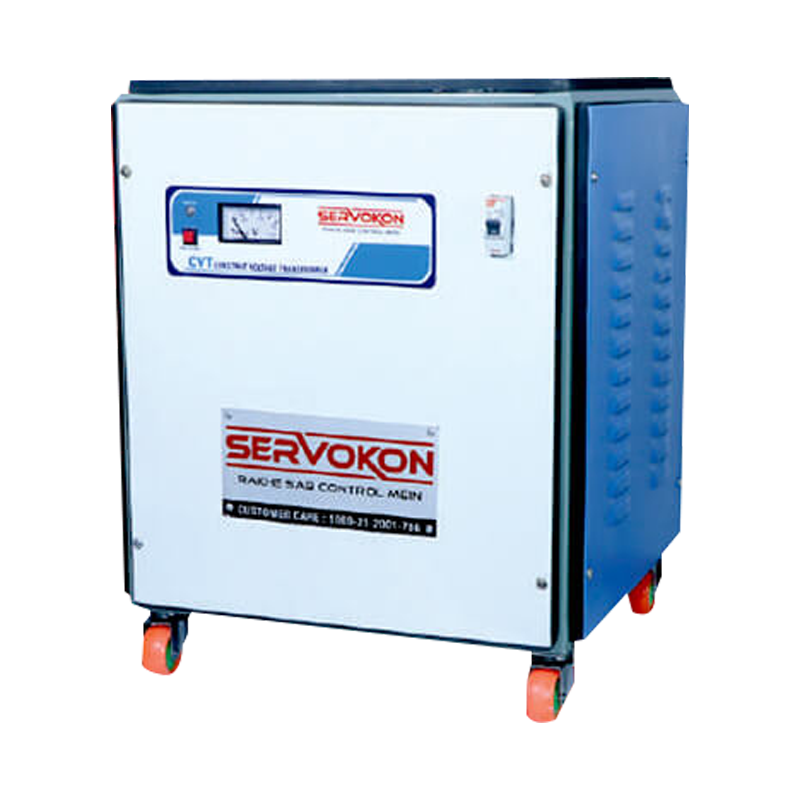
Servokon CVTs are produced using state-of-the-art ferror resonant technology. The product is Highly Economical & Reliable. It gives you Instantaneous Voltage regulation, no transient, no spikes, sinewave output, noiseless operation and high isolation between output & Input. Recommended for Petrol Pump, Wheel balancing Machines, Dental Chairs, Medical Equipments, Control Panels, EPBAX Machines, CCTV etc.
Features
Minimum Maintenance
Short term overload Capacity
Instantaneous Short Circuit & Overload Protection
Surge Suppression & Spike Protection
No Semiconductor or Moving parts used
Instant Correction Speed
TECHNICAL SPECIFICATIONS
| Capacity | 100 VA to 10 KVA (Any Special Customised Capacity as per Customer Requirement) |
| Input Voltage | 180V-260V & 160V-260V (Any Special Customised Range as per Customer Requirement) |
| Output Voltage | 220/230/240 V [+1% ] Phase to Neutral |
| Frequency | 50/60 Hz ± 5% |
| Load Variation | Admitted from 0 to 100% |
| Operating Temperature | -15°C to +50°C |
| Response Time | 10-20 milliseconds |
| Waveform Distortion | Nil (Negligible) |
| Correction Rate | Instantaneous |
| Cooling | Air Natural (AN) |
| Winding | 100% Copper |
Advanced Voltage Regulation for Sensitive EquipmentThe CVT Voltage Stabilizer's ferro-resonant transformer ensures stable output voltage (220V/230V AC) free from harmonic and waveform distortion. With built-in circuit breaker protection and compliance to strict IS 9815/IEC standards, these units guarantee precise safeguarding of critical devices across commercial, industrial, and residential installations.
Versatile Design with Reliable Cooling OptionsChoose between air cooled and oil cooled models for optimal thermal management depending on application, ambient conditions, and installation environment. Compact, robust sheet metal or steel enclosures provide durability and protection, while versatile connection types (terminal, plug, socket) allow easy integration with various systems.
FAQ's of CVT Voltage Stabilizers:
Q: How do CVT Voltage Stabilizers ensure voltage consistency in fluctuating power conditions?
A: The stabilizers use a ferro-resonant transformer design that instantly responds to voltage changes, maintaining a steady output voltage (220V/230V AC) regardless of fluctuations within the input range (180V - 270V AC). This protects sensitive equipment from damage due to under or overvoltage.
Q: What are the main benefits of using an air cooled versus an oil cooled CVT Voltage Stabilizer?
A: Air cooled models suit environments with moderate ambient temperatures and where space constraints exist, offering easy installation and low maintenance. Oil cooled units are preferable for higher power applications or environments with elevated temperatures, as they provide superior thermal management and prolonged operational lifespan.
Q: When is it most suitable to use these stabilizers in residential or industrial settings?
A: These stabilizers are recommended wherever consistent voltage is crucial-such as in homes with delicate appliances, industrial machinery, or commercial offices with sensitive electronics. Their wide power rating range (500 VA to 50 KVA) allows selection according to load requirements.
Q: Where can these stabilizers be installed, and what mounting options are available?
A: CVT Voltage Stabilizers are designed in compact, cabinet-mounted enclosures suitable for indoor installation. The degree of protection (IP20) ensures safety from touch and ingress of solid objects-ideal for placement in utility rooms, control panels, or designated power rooms.
Q: What is the process for connecting this stabilizer to an electrical system?
A: Installation involves connecting input terminals or plugs to the main AC supply, and output terminals or sockets to the load. Digital or analog meters provide real-time monitoring, and built-in circuit breaker protection simplifies the setup for quick, safe deployment.
Q: How does the built-in overload and voltage protection benefit the user?
A: Integrated overload circuit breakers and over/under voltage protection safeguard both the stabilizer and connected equipment, automatically disconnecting the load during abnormal conditions. This minimizes risk of equipment malfunction, fire hazards, and costly downtime.